Alaska Dog Registration Information
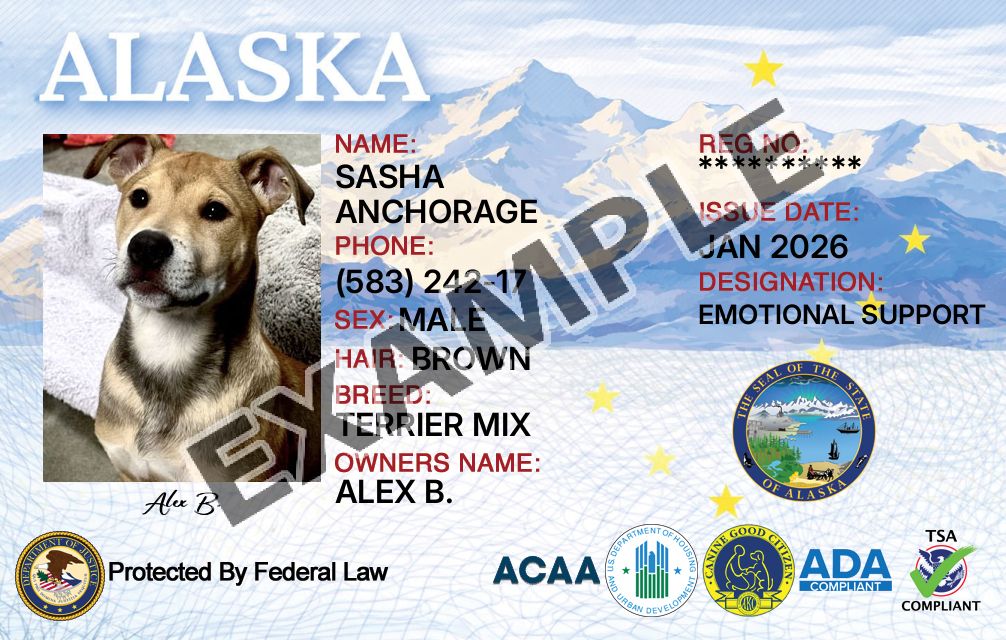
State Licensed, Service Dogs and Emotional Support Dogs in Alaska
If you’re asking where do I register my dog in Alaska for my service dog or emotional support dog, the most important thing to know is this: in Alaska, “registration” usually means a local dog license (when required), and it’s typically handled by your city or borough animal control—not by a single statewide “service dog” or “ESA registry.” In other words, where to register a dog in Alaska depends on where you live (Anchorage vs. Fairbanks vs. Kenai vs. Sitka, etc.).
This page explains how a dog license in Alaska works, how rabies vaccine rules connect to licensing, and what makes a dog a service dog (legal status) versus an emotional support animal (housing-related support). You’ll also find example official offices you can contact for an animal control dog license Alaska question, especially if you’re wondering exactly where to register a dog in Alaska in your community.
Where to Register or License Your Dog in Alaska
Because licensing and animal control are often handled at the municipal or borough level, below are several example official offices in Alaska that handle animal control, dog licensing, or rabies-related enforcement within their jurisdictions. Contact the office that matches your physical address (where your dog actually resides).
Municipality of Anchorage — Animal Care & Control
Fairbanks North Star Borough — Animal Control
City & Borough of Juneau — Juneau Animal Rescue (Animal Control & Licensing)
City of Kenai — Animal Control / Kenai Animal Shelter (Dog Licenses)
City & Borough of Sitka — Animal Control (Sitka Animal Control Shelter)
Matanuska-Susitna Borough — Borough Contacts (Animal Care & Regulation Director)
Overview of Dog Licensing in Alaska
Is there a statewide Alaska dog registration?
For most residents, there is no single statewide place to “register” every pet dog. Instead, dog licensing in Alaska is usually local. Many Alaska communities require a dog license in Alaska through municipal animal control or a city/borough contractor, and the rules can change based on city limits, borough boundaries, and local ordinances.
What a dog license does (and doesn’t do)
A dog license is typically a local government record that links your dog to you as the owner/custodian and confirms basic compliance requirements—often including current rabies vaccination. This is why you’ll often see the terms animal control dog license Alaska and “rabies control” used together.
A dog license generally does not determine whether your dog is a service dog or emotional support animal. It’s a separate concept: your dog can be licensed as required by your city/borough and still be a pet, a service animal, or an ESA depending on the situation and legal definitions.
Rabies vaccination requirements (how they connect to licensing)
Alaska’s public health guidance emphasizes keeping pets’ rabies vaccinations up to date and notes that reporting and bite procedures are often handled locally rather than through one statewide office. In practice, many Alaska jurisdictions require proof of current rabies vaccination before issuing or renewing a dog license. For example, Anchorage ties license validity to rabies vaccination status (licenses expire in conjunction with the rabies vaccination).
How Dog Licensing Works Locally in Alaska
Step 1: Confirm your jurisdiction (city limits vs. borough vs. rural)
The answer to where to register a dog in Alaska starts with your street address. Alaska has a mix of city governments, borough governments, and rural/unincorporated areas. Some places have a dedicated animal control department; others contract services or handle animal issues through public safety or a local shelter partner.
Step 2: Gather common requirements
While details vary, many local Alaska licensing processes ask for:
- Owner contact information and physical address
- Dog description (breed/color/sex/age) and spay/neuter status
- Proof of current rabies vaccination (often required to issue the license)
- Payment of the licensing fee (often discounted for altered/spayed/neutered dogs)
Some areas offer online, in-person, or mail-in licensing. Anchorage, for example, allows licensing/renewal and requires proof of current rabies vaccination for issuance.
Step 3: Know what “registration” means for service dogs or ESAs
If your goal is to “register my dog as a service dog” or “register my dog as an emotional support dog,” you should separate two different actions:
| Action | What it usually means in Alaska | Who handles it |
|---|---|---|
| Dog license | Local record/tag showing your dog is licensed (when required) and often that rabies vaccination is current. | City/Borough Animal Control, shelter contractor, or local licensing office. |
| Service dog status | Legal status based on the dog being trained to perform tasks for a person with a disability (not a paid online registry). | Determined by law/definition and your situation; not “issued” by a registry. |
| Emotional support animal (ESA) | Generally relevant to housing accommodations and supported by appropriate documentation from a qualified professional (not a government pet license). | Typically handled between you and a housing provider under applicable housing laws; not a dog license office function. |
If you’re unsure: call local animal control and ask these questions
- Do you require a dog license for my address, and at what age?
- Do you require rabies vaccination proof to license or renew?
- Is licensing annual or multi-year? Does it expire when the rabies vaccine expires?
- Do you offer fee waivers or discounts (for seniors, altered dogs, working dogs, etc.)?
- If my dog is a service dog, do I still need a local license/tag?
Service Dog Laws in Alaska
Service dog vs. pet: the practical difference
A service dog is generally a dog that is individually trained to do work or perform tasks for a person with a disability. The training and task performance are what matter—not an online “registration” purchase. Many people still choose to use helpful gear (like a vest), but a vest or ID card is not the same thing as legal status.
Do service dogs need a dog license in Alaska?
Often, yes—if your city/borough requires all resident dogs to be licensed, that typically applies regardless of whether the dog is a pet or a service animal. Some jurisdictions may offer special provisions (for example, certain working dogs or public safety dogs may have different fees or rules). The key point: a service dog is not “registered” through animal control, but the dog may still need to comply with local licensing and rabies requirements.
What local offices can (and can’t) do
Animal control can usually help you with licensing, replacement tags, and rabies-related compliance. They typically do not “certify” your dog as a service dog. If a business or landlord asks for improper documentation, it may help to know that the dog’s training and behavior are central, and the dog must be under control and housebroken in public settings.
Emotional Support Animal Rules in Alaska
What an emotional support animal (ESA) is
An emotional support animal provides comfort or emotional support that can help with a person’s mental or emotional disability. ESAs are most commonly relevant in housing contexts (requests for reasonable accommodation). An ESA is not the same as a task-trained service dog.
Do ESAs get a special Alaska “registration”?
Typically, no. You generally do not “register” an ESA with the State of Alaska or with animal control to make it an ESA. Instead, ESA status is usually supported by documentation from an appropriate professional when you request a housing accommodation. Separately, your dog may still need a dog license in Alaska if your city/borough requires licensing for resident dogs.
ESAs and dog licensing are separate
Think of it this way: a dog license is about local public health/safety (ID, rabies compliance, local rules). ESA documentation is about access/accommodation rules (usually housing). One does not replace the other—and paying for a “registry” online is not the same as meeting your local licensing requirements.
Frequently Asked Questions
Where do I register my dog in Alaska for my service dog or emotional support dog?
For most people, you register/license your dog through your local city or borough animal control (or their designated shelter/office) if your area requires licensing. Service dog and ESA “registration” is commonly misunderstood—service dog status comes from task training for a disability, and ESA status is typically relevant to housing accommodations, not a government licensing database.
Is a “service dog registry” required in Alaska?
A local animal control office may require a dog license, but that is different from a “service dog registry.” If someone is selling a certificate or ID card as the only way to “register” a service dog, treat that as a red flag.
Do I need rabies vaccination to get an Alaska dog license?
In many Alaska jurisdictions, yes—proof of current rabies vaccination is commonly required for licensing and renewal. Some places also align license expiration to the rabies vaccination expiration date, so staying current helps you avoid lapses.
What if I live outside city limits?
Requirements vary widely in Alaska. If you’re outside a city, your borough may handle animal control, may contract services, or may have different rules than the nearest city. Start with the borough contact info and ask who handles licensing or animal control enforcement for your specific address.
Does licensing prove ownership?
A license record and tag can help connect a found dog back to you and may support proof of custody, but it doesn’t replace microchipping, ID tags, vet records, or other documentation. Many owners use licensing, microchipping, and collar ID together.
What should I say when I call an office to ask where to register a dog in Alaska?
Keep it simple and location-based:
- “I live at [your city/neighborhood]. Do you require a dog license for resident dogs?”
- “What proof do I need—rabies certificate, ID, and proof of residency?”
- “Can I license by mail/online/in person, and what are your hours?”
- “My dog is a service dog/ESA. Do the same licensing and rabies requirements apply?”
Register A Dog In Other Alaska Counties
Select your county from the dropdown below to get started with your dog’s ID card. Requirements and license designs may vary by county, so choose your location to see the correct options and complete your pup’s registration.
- Aleutians East Borough County Dog Registration
- Aleutians West Census Area County Dog Registration
- Anchorage Borough County Dog Registration
- Bethel Census Area County Dog Registration
- Bristol Bay Borough County Dog Registration
- Chugach Census Area County Dog Registration
- Copper River Census Area County Dog Registration
- Denali Borough County Dog Registration
- Dillingham Census Area County Dog Registration
- Fairbanks North Star Borough County Dog Registration
- Haines Borough County Dog Registration
- Hoonah-Angoon Census Area County Dog Registration
- Juneau County Dog Registration
- Kenai Peninsula Borough County Dog Registration
- Ketchikan Gateway Borough County Dog Registration
- Kodiak Island Borough County Dog Registration
- Kusilvak Census Area County Dog Registration
- Lake and Peninsula Borough County Dog Registration
- Matanuska-Susitna Borough County Dog Registration
- Nome Census Area County Dog Registration
- North Slope Borough County Dog Registration
- Northwest Arctic County Dog Registration
- Petersburg Borough County Dog Registration
- Prince of Wales-Hyder Census Area County Dog Registration
- Sitka Borough County Dog Registration
- Skagway Borough County Dog Registration
- Southeast Fairbanks Census Area County Dog Registration
- unorganized borough County Dog Registration
- Wrangell Borough County Dog Registration
- Yakutat Borough County Dog Registration
- Yukon-Koyukuk Census Area County Dog Registration